Price drivers
Treatment area, pavement temperature, precipitation, application count, and material choice set the price of sanding & traction control.
Greater Burlington winter service
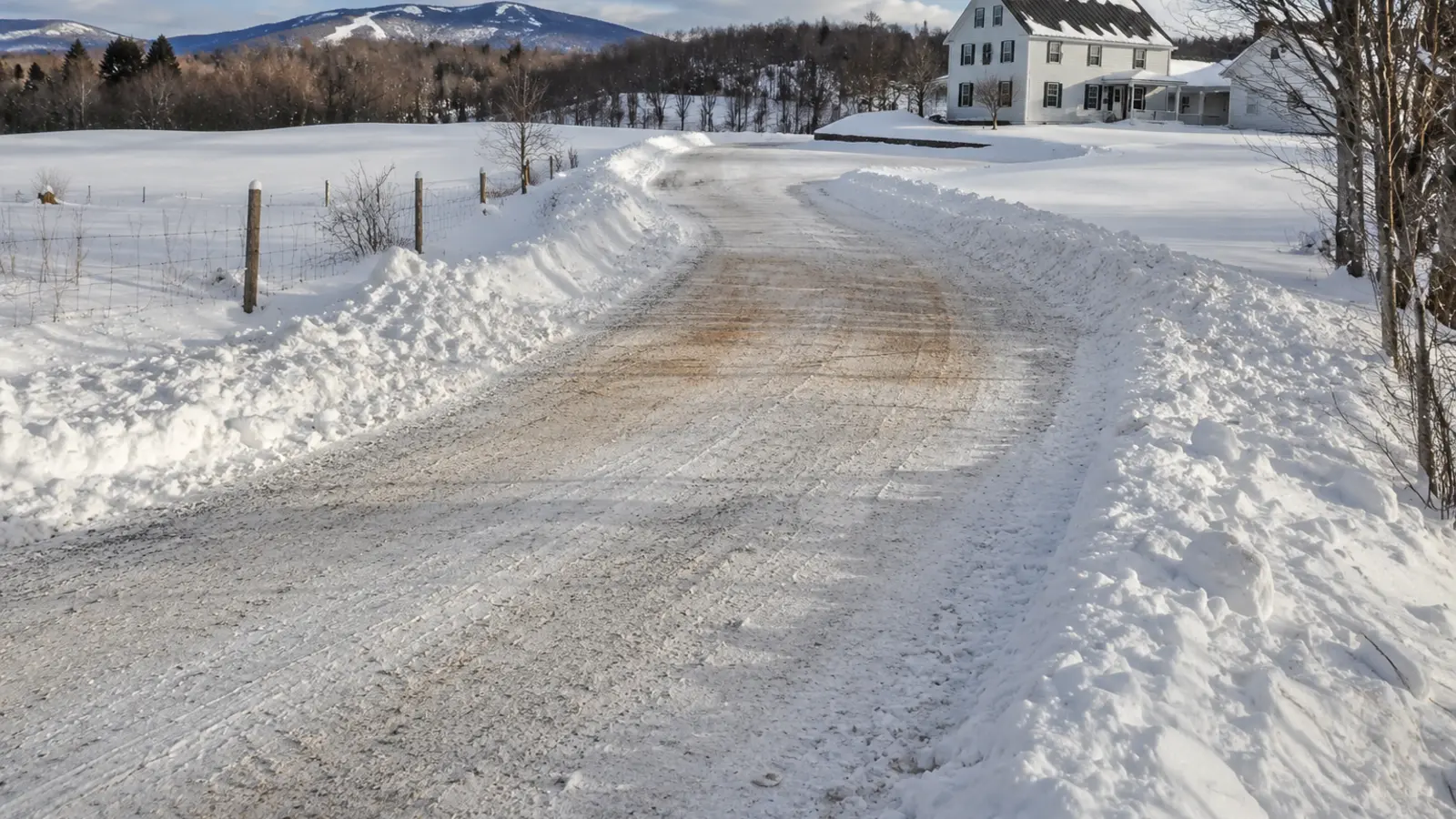
Winter sand applied where vehicles and pedestrians need grip without relying only on melting action.
Model the property✓ Gravel drives and private roads
✓ Steep approaches and curves
✓ Intersections and stopping zones
✓ Spot or full-route treatment
Service in plain language
Winter sand applied where vehicles and pedestrians need grip without relying only on melting action.
Sand improves traction but does not melt ice. It is especially useful on gravel surfaces or during very cold conditions, and it can be targeted to grades, corners, and stopping areas.
Spring cleanup, drainage, and material tracking should be considered when deciding how broadly to apply it.
Operating decision
On a sanding & traction control property, deicer helps break a bond under suitable conditions. Sand provides grip. For sanding & traction control, neither replaces drainage work, and neither guarantees bare pavement during active freezing rain.
On a sanding & traction control property, specify the surface, treatment zone, weather trigger, repeat-application authority, environmental limits, and spring cleanup responsibility.
For sanding & traction control, the proposal should name the activation point, mapped work area, visit standard, exceptions, and separately authorized work.
Treatment area, pavement temperature, precipitation, application count, and material choice set the price of sanding & traction control.
For sanding & traction control, you set the priority access, the finish standard, the legal storage area, the treatment zones, and who may approve added work.
With sanding & traction control, bare pavement, unlimited applications, drainage correction, and spring sweeping are not implied.
Related winter work
See every option on the snow and ice services page.
Straight answers
A residential-scale traction application commonly runs $45–$130; private roads and long rural drives price by the run and by how much of the route needs treating. Checked September 2026. Sand is often cheaper than repeated deicing on the surfaces it suits, but it carries a cost most people forget — spring cleanup, which should be assigned in the agreement rather than discovered in April.
No, and that is the whole point of choosing it. Sand provides mechanical grip on top of ice regardless of temperature, which makes it useful exactly where deicers fail: deep cold, gravel surfaces, and shaded pitches that never warm enough for chemistry to work. The ice stays; the traction improves.
On gravel, where deicers do little. In deep cold, below the working range of rock salt. On steep and shaded sections where the surface will refreeze regardless. Near planting, water or concrete you want to protect. And on any surface where the objective is a vehicle stopping and starting safely rather than a bare surface.
In zones, not uniformly. The places that earn it are the steepest pitch, the inside of curves, the approach to a stop at a public road, the point where vehicles have to start uphill from rest, and the pedestrian transitions. Spreading a route evenly uses several times the material for less benefit, and it makes the spring recovery much larger.
Until it is buried, tracked away, or melted into the surface — which on an active route can be a single day, and after a fresh accumulation is effectively immediately. Sand under new snow does nothing for the new surface. Properties relying on traction control should expect repeat applications through a storm cycle rather than one treatment per event.
It ends up on the shoulder, in the lawn, in the ditch, at the bottom of the grade, and in the first drainage structure downhill. Recovering it is a real task — sweeping, raking, sometimes removing it from a catch basin — and it should be named in the agreement as included or excluded. It is also why sand near a stream or pond needs care about where it will finish up.
It has different impacts from salt rather than none. It does not add chloride to soil and groundwater, which is its main advantage. It does add sediment to whatever it washes into — ditches, catch basins, streams — and sediment is a genuine water-quality concern in this region. Keeping application targeted and recovering it in spring is what keeps that impact small.
Commonly, as a blend or as separate applications in different zones on the same property. The blend gives some immediate grip plus some melting, and it suits mixed surfaces. What it should not be is a default: a property with paved entrances and a long gravel approach usually does better with salt on the first and sand on the second than with one blended material everywhere.
Yes, and it is often the better choice there — it gives grip immediately, works at any temperature, and does not attack concrete or planting the way chloride does. Its drawback on pedestrian routes is that it tracks indoors relentlessly, which is a housekeeping cost rather than a safety one.
Less than salt does, but not nothing. It abrades some surfaces, accumulates in drainage, gets tracked into buildings and vehicles, and on a gravel drive adds to the material that has to be regraded. Those are manageable and mostly seasonal costs, which is why sand is the default recommendation on rural properties in this region.
Far less than the whole length if it is applied to zones rather than spread. A typical long approach has two or three places that genuinely matter — the pitch, the curve, and the stop at the public road — and treating those well beats treating the whole drive lightly. That is also what keeps the spring recovery to a manageable job.
On private roads and long rural properties it frequently makes sense: a covered pile on the property means treatment can happen without a material run, which matters when a route is long. It needs somewhere it will not wash into drainage, cover so it does not freeze into a block, and agreement about who replenishes it.
It improves traction on the treated zones, under the conditions present when it was applied. It does not make a surface safe, does not persist through a new accumulation, and does not remove the ice underneath it. A sanded hill is a hill you have a better chance on, not a hill that is no longer icy.
Winter starts before the forecast
Map the property, choose the right service trigger, and decide where the snow should go before the first route rolls.