Greater Burlington winter service
Driveway Plowing
A route-ready driveway plan with the right trigger, snow placement, and finish work.
Build a snow planning range✓ Paved, gravel, and mixed surfaces
✓ Curves, hills, gates, and narrow approaches
✓ Garage doors and turnaround areas
✓ Storm and post-storm passes
Service in plain language
Clean, repeatable driveway service for short urban drives and long country approaches.
Driveway length alone does not determine the work. Width, pitch, backing distance, turnaround space, surface, obstructions, and snow-storage capacity all influence the visit. For gravel, early-season technique matters: a raised blade or packed base can reduce displaced stone until the drive freezes. For pavement, scrape quality and ice strategy become more important. The tightest point sets the limit. A driveway that narrows toward the road or ends at a steep pitch changes which equipment can complete the job safely. So the tightest point matters more than the average width. Confirm the preferred stacking side in writing before the season: a bank placed on the wrong side can block a mailbox, a meter, or a neighbor's sightline for the rest of the winter, a detail far easier to fix in October than in January.
What a driveway plowing visit should include
Short paved drives run $40–$100 a visit. Residential triggers usually sit at 2–3 inches.
Price bands checked September 2026: HomeBlue, HomeAdvisor, Angi, HomeGuide, Housecall Pro.
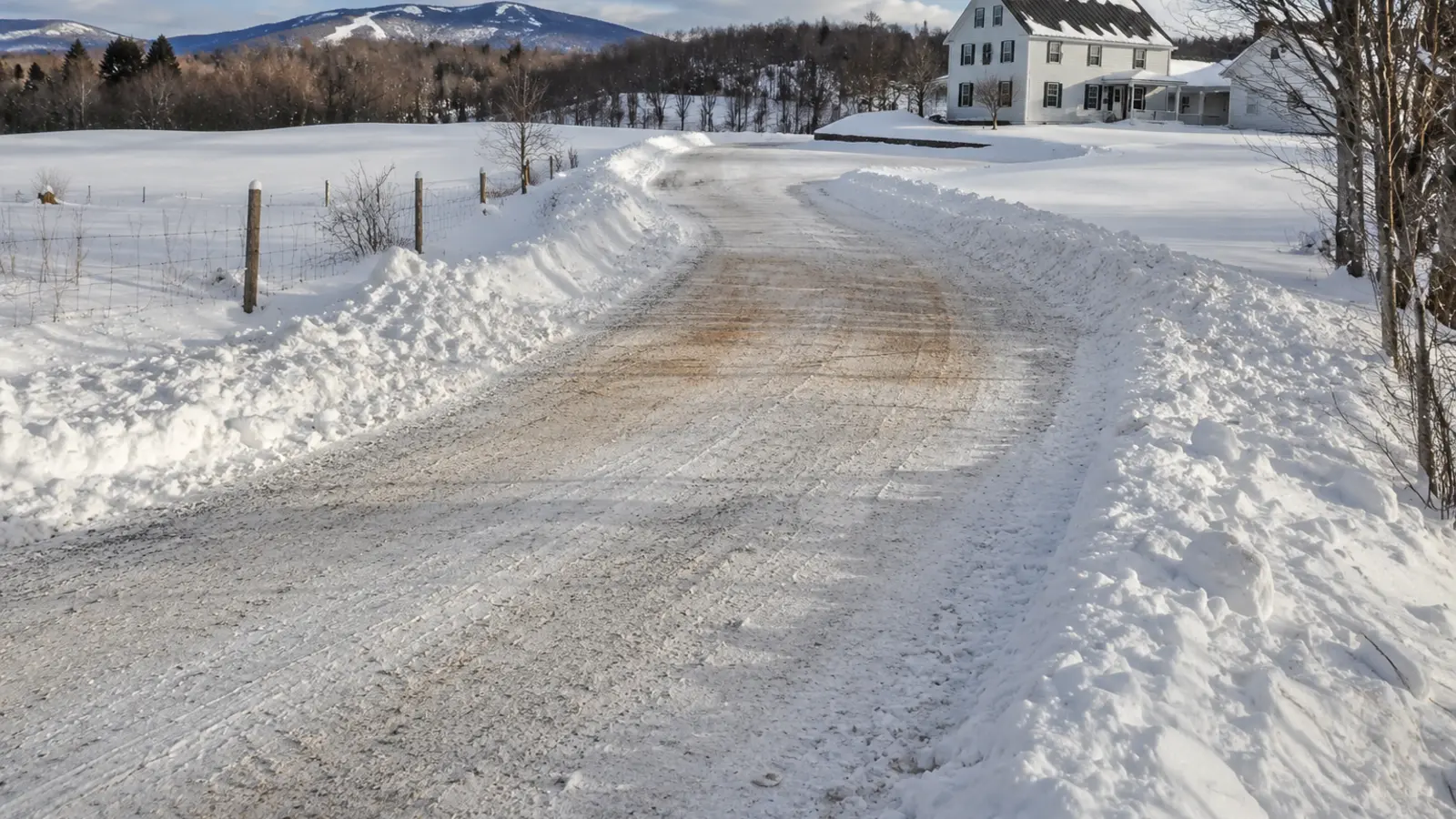
Scope reference
What is included and what is quoted separately
| Typically included | Quote separately |
|---|---|
| Paved, gravel, and mixed surfaces | Walkway or sidewalk treatment |
| Curves, hills, gates, and narrow approaches | Snow widening or hauling |
| Garage doors and turnaround areas | Moved-vehicle cleanup |
| Storm and post-storm passes | Hidden-object repair |
Related winter work
Related winter services
Scope decisions rarely stand alone. See every option on the snow and ice services page.
Straight answers
Questions to settle before the snow flies
What makes one driveway more expensive to plow than another?
Time on site. Geometry drives that time, not length. The variables that move it most: how many reversing manoeuvres the layout forces, whether there is a turnaround or the truck must back the whole way out, the width available for the blade, the grade, the surface, how many separate zones exist (apron, parking area, garage front), and whether there is anywhere left to put snow by February. A 60-foot drive with no turnaround can cost more than a 200-foot straight run.
Is a gravel driveway plowed differently from a paved one?
Substantially. Until the base freezes hard, a blade set at pavement height peels the crown into the ditch. So early-season visits run the blade high or on shoes and deliberately leave a thin packed layer to work from. Edges have to be staked in autumn because the boundary is invisible by December. And spring stone recovery, raking displaced gravel back out of the lawn and off the apron, is real work that should be assigned to someone in writing before the season.
How wide will the driveway actually be cleared?
Narrower than it is, and narrower each storm unless banks are pushed back. Blades clear to the edge of the pass, and each pass stacks a bank slightly inside the last one. So a drive loses usable width progressively across a winter. Agree the intended cleared width up front, and agree the trigger for widening, usually when the drive can no longer take a vehicle plus a passing manoeuvre.
Where should the snow from my driveway go?
Downhill of the cleared surface, away from the road apron, clear of drainage, and never across the public right of way or onto a neighbour's lot. The mistake that causes the most repeat trouble is stacking uphill: meltwater runs back across the driveway and refreezes overnight. So the property regenerates its own ice every day of a thaw. Pick the storage areas in autumn while the ground is visible and mark them.
What if the driveway is too steep to plow safely?
Grade limits what a truck can do while pushing a loaded blade, and a steep drive with a curve or a drop-off may need to be cleared uphill-first, or with different equipment, or accepted as a traction-managed surface, not a bare one. The honest test is whether a loaded vehicle can stop and restart partway up on a glazed morning. If it cannot, the property needs sand at the pitch, the curve and the stopping point as part of the standing plan.
Does driveway plowing include the garage apron?
It should be named explicitly. The apron is where the equipment cannot reach cleanly. A blade leaves a windrow across the door line on the final pass, and clearing it properly usually means hand work or a blower. If you expect to open the garage door after a visit, say so in the scope: that expectation is a line item, not an assumption.
Can a driveway be plowed while cars are parked in it?
Partially, which is usually worse than either alternative. The operator clears what is reachable, and the remainder ices under the vehicles and gets harder every storm. The workable arrangements are: one space kept clear during events, everyone out before a stated time, or an agreed return pass after vehicles move. Whichever you choose belongs in the agreement, along with who pays for the return.
How long does a driveway plowing visit take?
A straightforward short paved drive is a few minutes. Long, gravel, steep, multi-zone or obstructed drives run considerably longer, and that duration is what the price reflects. Worth knowing for expectation-setting: during a large regional event a route may take many hours end to end, and properties are cleared in route order, not in order of who called.
What is a "clean-up pass" and do I need one?
A second visit after the storm ends, or after vehicles move, to finish what the opening pass could not. On a property where access must stay open during a long storm, the opening pass keeps the drive usable and the cleanup pass produces the finished condition. Whether one, both, or an unlimited number are included is a pricing question that has to be settled before the winter, not during it.
Does the contractor mark my driveway edges, or do I?
Establish this early, because unmarked hazards are the main source of damage disputes. Many operators stake the drive as part of a pre-season visit; others expect the owner to. Either way the things that need marking are the same: the usable edges, culvert ends, soft shoulders, drainage outlets, surface transitions, low walls, sprinkler heads, and anything that will be invisible under a foot of snow.
Can a driveway plowing agreement be added mid-winter?
Sometimes, at a higher price and a worse route position, and sometimes not at all. Route capacity is fixed once a contractor is committed, and inserting a property mid-season affects the timing for everything behind it. Mid-winter requests also cannot be scoped properly, nobody can see the edges. So the price carries the uncertainty.
Is driveway plowing the same as snow removal?
No, and the distinction becomes expensive in February. Plowing pushes snow to a storage area on your property. Snow removal, in the trade sense, relocates or hauls it away once the storage areas are full. They are separate line items with separate triggers, and a property with no removal plan simply runs out of room.
Will my driveway be safe to walk on after plowing?
Not necessarily, and no contractor can promise it will be. A plowed surface is a cleared surface, not a de-iced one. The remaining thin layer can compact and glaze, meltwater can refreeze across it overnight, and freezing rain can restore the hazard minutes after the truck leaves. Traction treatment is a separate service, and even with it the surface only improves. It does not become safe.
Where the price figures come from
Every dollar range on this page is taken from these published cost guides, read September 2026. They are planning ranges, not quotes.
- HomeBlue, Snow Removal Cost in Burlington, Vermont (published October 12, 2022): Burlington plowing runs $40 to $100 a visit by driveway size; snow blowing $51 to $77 an hour.
- HomeAdvisor, What Is the Cost of Snow Removal? (updated June 19, 2026): Seasonal contracts $200 to $700; sand and salt $20 to $40 a visit; commercial plowing $50 to $200 an hour; $51 to $203 a visit overall.
- Angi, How Much Does Snow Removal Cost? (updated April 6, 2026): Seasonal contracts $300 to $700; $51 to $203 a visit, averaging $126.
- HomeGuide, Snow Removal Cost (2026): Driveway up to 90 feet $30 to $70; steep or gravel $50 to $100 and up; salt $20 to $65 an application; sidewalk clearing $25 to $75 an hour.
- Housecall Pro, Snow Removal Price Guide 2026 (updated March 12, 2026): Seasonal contracts $350 to $600; on-site hauling $100 to $600 a visit; loader or skid-steer stacking $100 to $200 an hour.