Greater Burlington winter service
Private Road Plowing
Plowing, traction treatment, and widening strategies for roads that must stay usable through repeated storms.
Build a snow planning range✓ Shared lanes and road associations
✓ Turnouts and emergency-access widths
✓ Sand placement on grades and curves
✓ Bank management and turnaround clearing
Service in plain language
Route planning for shared lanes, associations, and private access roads.
Private roads require defined responsibilities. The service map should identify the plowed width, turnouts, intersections, culverts, steep segments, resident parking conflicts, and who can authorize extra work. A seasonal plan should also address where banks can be pushed, when widening is triggered, and whether sand is stockpiled or applied per event. A shared lane rarely has one obvious decision-maker. So name in writing who can authorize widening, who pays for it, and what happens when one household wants a different trigger than the rest of the association. Turnouts matter as much as the plowed width itself: a private road with no place to pass an oncoming vehicle during an active storm becomes a hazard the crew has to work around, not just a maintenance inconvenience.
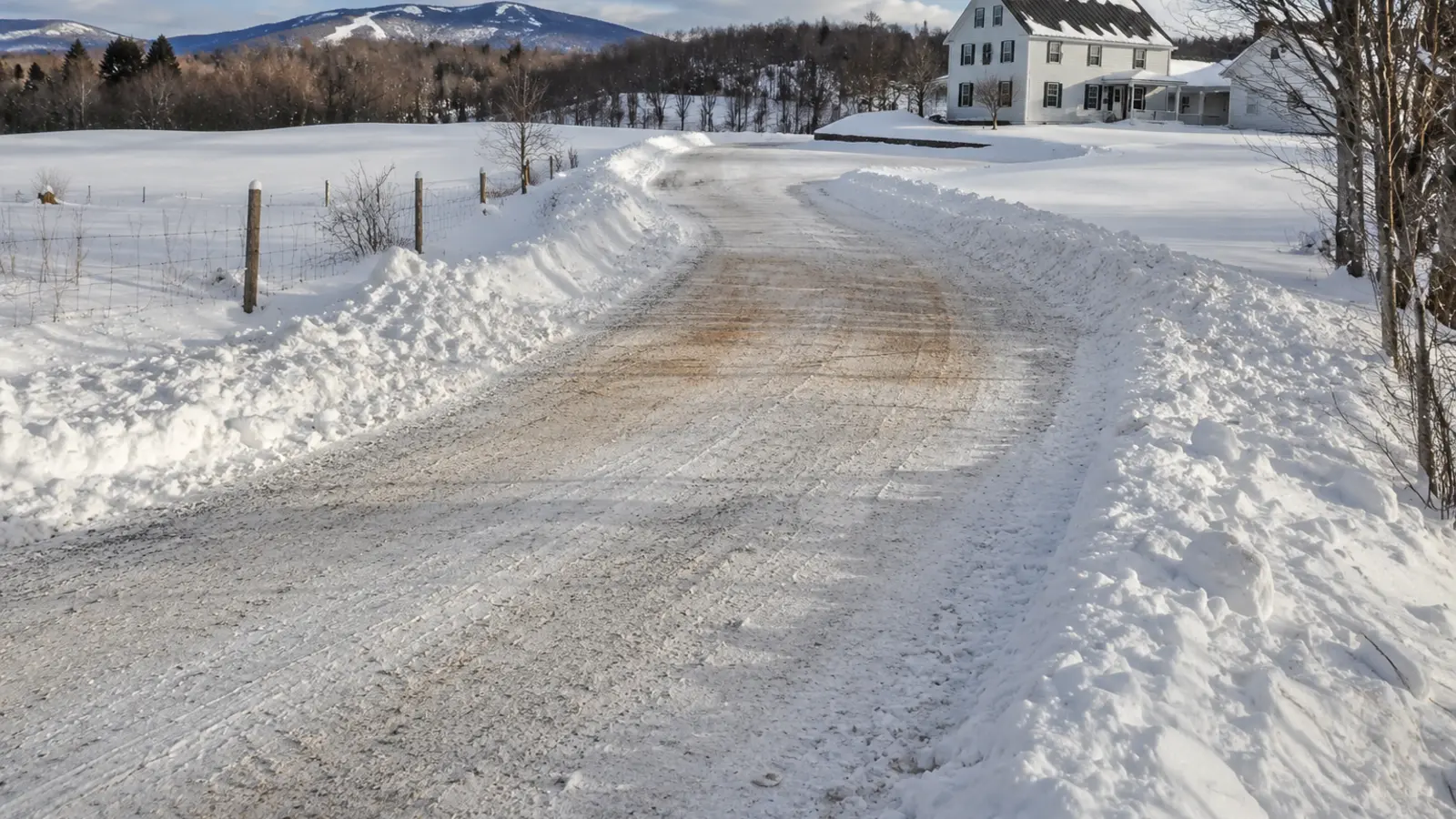
Private road plowing for a shared lane
Long or gravel approaches run $50–$200 a visit. The town does not plow a private road.
Price bands checked September 2026: HomeBlue, HomeAdvisor, Angi, HomeGuide, Housecall Pro.
Scope reference
What is included and what is quoted separately
| Typically included | Quote separately |
|---|---|
| Shared lanes and road associations | Walkway or sidewalk treatment |
| Turnouts and emergency-access widths | Snow widening or hauling |
| Sand placement on grades and curves | Moved-vehicle cleanup |
| Bank management and turnaround clearing | Hidden-object repair |
Related winter work
Related winter services
Scope decisions rarely stand alone. See every option on the snow and ice services page.
Straight answers
Questions to settle before the snow flies
Who is responsible for plowing a private road in Vermont?
The owners are: collectively, and that is exactly where it goes wrong. A private road, a shared lane, a road-association road and a Class 4 town road are all outside the municipal winter service, and no town crew will clear them regardless of how many households use them. Confirm the classification with the town before arranging anything; it is the single most common misunderstanding in this region and it is discovered in the first week of December.
How is private road plowing priced?
By length, plowed width, the number of turnouts and intersections, grade, surface, and how much traction material the road needs across a season, not by the number of households, although that is how the cost usually gets divided. Association roads are usually seasonal agreements, not per-visit, because per-visit billing across many owners produces an accounting problem every storm.
How wide should a private road be plowed?
Wide enough for two vehicles to pass and for an ambulance or fire apparatus to get through, and that width has to be maintained all season, not just achieved once in December. Roads narrow progressively as banks build. So the agreement should state the intended width, the trigger for pushing banks back, and who authorises the widening pass when it is needed.
Who authorises extra work on a shared road?
One named person, agreed before the season, with a stated spending limit. This is the clause that keeps association roads functional. Without it the operator is fielding competing instructions from several households during an active storm, and the road either gets worked twice or not at all while people confer.
What happens where a private road meets the public road?
The junction needs its own plan. Municipal plowing throws a berm across the mouth of the private road, sightlines at the intersection have to stay open, and snow cannot be stacked into the public right of way. Decide in advance whether clearing that junction is part of the road scope and where the snow from it goes. It is often the one place with no room.
Do private roads need sand or salt?
Sand, usually, and targeted. Spreading it uniformly wastes it. Private roads are frequently gravel, often shaded, often graded, and salt does little useful work on an unpaved surface. The useful specification names zones, the steepest pitch, the curves, the stopping point at the public road, the approach to each turnout, not a quantity. A treatment run commonly costs $20–$60 on a residential-scale road.
Where does the snow go on a road with ditches on both sides?
Over the ditch and beyond it, not into it, which is why a road plow throws snow further than a driveway blade. Filling ditches with snow blocks the drainage the road depends on, and the meltwater then crosses the travelled surface and refreezes. Culvert ends need marking in autumn so they are not buried or struck.
What about turnarounds and dead ends on a private road?
They are the constraint on what equipment can service the road at all, and they fill with snow first because that is where every pass ends. A dead end with no turnaround means the operator backs out the entire length, which changes the price and, past a certain distance, changes whether the road can be serviced. Measure the turnaround before requesting a price.
How are costs divided among households on a private road?
That is the association's decision, not the contractor's, and it should be settled in writing before the contract is signed. Equal shares, shares by frontage, and shares by road-length-used are all in use and all defensible. What causes trouble is an undivided invoice and an assumption that everyone will agree in March.
What if one household on the road will not pay?
The contractor's agreement is with whoever signed it. So the shortfall lands on the association, not on the operator, and the operator is under no obligation to stop servicing a road because of an internal dispute. A written association agreement and a single billing contact beat an informal arrangement between neighbours for exactly this reason.
Does private road plowing include the driveways off it?
No, unless each is separately scoped. Road plowing clears the travelled way; individual driveways are individual properties with their own surfaces, grades, obstructions and storage. Several households often add their drives to the same contractor for the efficiency, but each is its own line item.
Does a private road need to be staked before winter?
More than a driveway does, because the consequences are worse. Stakes go outside the usable travelled width, not in the ditch, at culvert ends, soft shoulders, width changes, drop-offs, and anywhere the road narrows. On a long road that is a real autumn task, and it is what makes the road workable in the dark during an active storm.
Is emergency access guaranteed on a private road?
No. A private road agreement improves the chance that emergency vehicles can get through, and stating the required width for that purpose is exactly why it belongs in the scope. But no contractor can guarantee a road is passable at any given moment during or after a storm, and households on private roads should plan for periods when it is not.
Where the price figures come from
Every dollar range on this page is taken from these published cost guides, read September 2026. They are planning ranges, not quotes.
- HomeBlue, Snow Removal Cost in Burlington, Vermont (published October 12, 2022): Burlington plowing runs $40 to $100 a visit by driveway size; snow blowing $51 to $77 an hour.
- HomeAdvisor, What Is the Cost of Snow Removal? (updated June 19, 2026): Seasonal contracts $200 to $700; sand and salt $20 to $40 a visit; commercial plowing $50 to $200 an hour; $51 to $203 a visit overall.
- Angi, How Much Does Snow Removal Cost? (updated April 6, 2026): Seasonal contracts $300 to $700; $51 to $203 a visit, averaging $126.
- HomeGuide, Snow Removal Cost (2026): Driveway up to 90 feet $30 to $70; steep or gravel $50 to $100 and up; salt $20 to $65 an application; sidewalk clearing $25 to $75 an hour.
- Housecall Pro, Snow Removal Price Guide 2026 (updated March 12, 2026): Seasonal contracts $350 to $600; on-site hauling $100 to $600 a visit; loader or skid-steer stacking $100 to $200 an hour.
Agree on the association payment split
Write down whether households pay equal shares, shares by frontage or shares by road length used. The contractor bills the party who signed the agreement; the association needs its own way to handle a missed household payment. Revisit that split when a household joins or leaves.
Map turnouts and the dead-end turnaround before choosing equipment. Assign the public-road junction separately, including the berm left by the municipal plow. Confirm road classification and winter maintenance with the town.