Greater Burlington winter service
Commercial Snow & Ice Management
Commercial Snow & Ice Management: site-specific service plans for businesses, offices, multifamily properties, associations, and managed facilities.
Build a snow planning range✓ Parking lots and traffic lanes
✓ Entrances, loading zones, and fire access
✓ Walkway and curb-transition coordination
✓ Service logs and storm communication
Service in plain language
Coordinated winter service for lots, entrances, loading areas, and pedestrian routes.
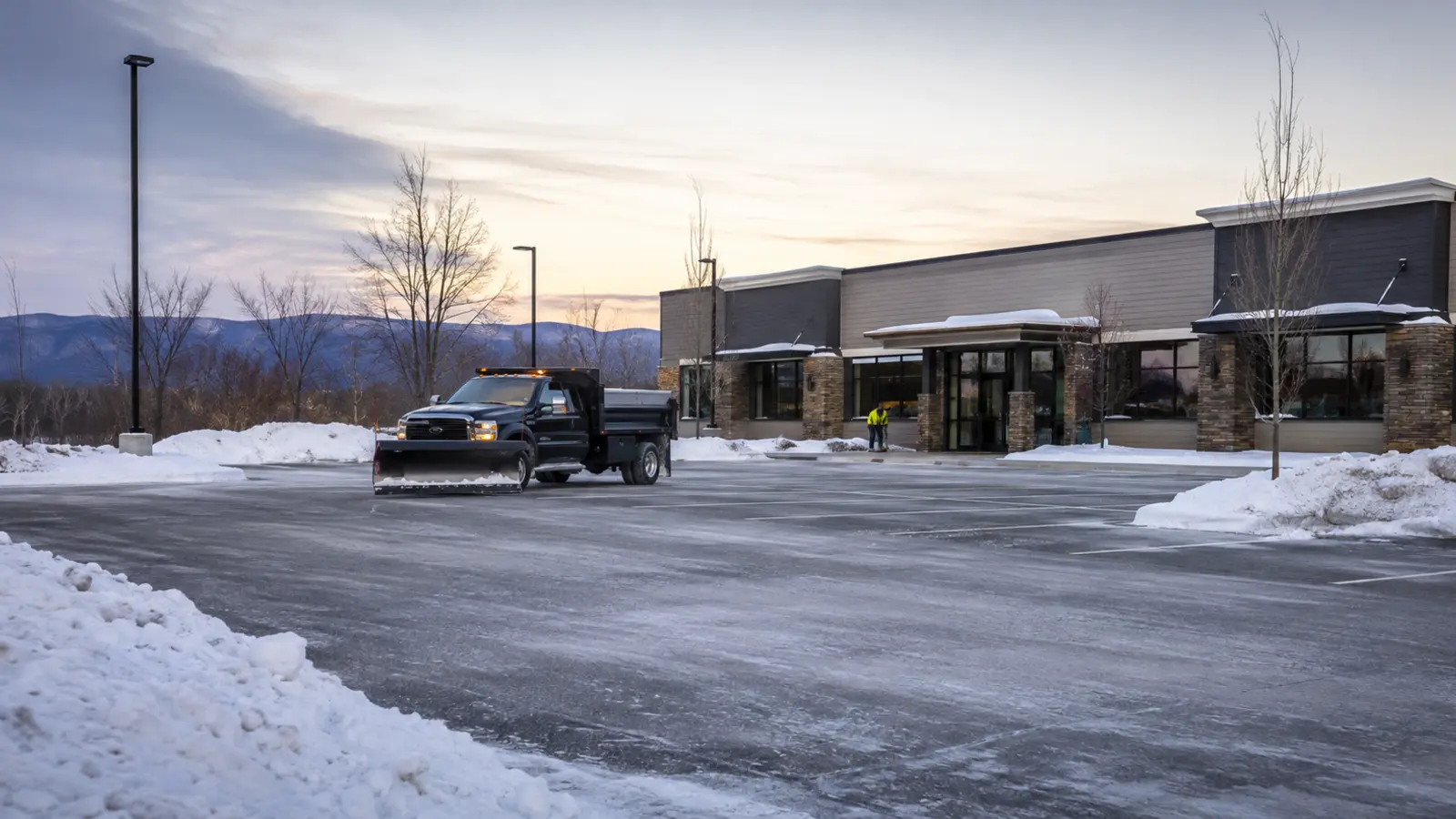
Commercial winter work is an operations problem. A site map should define priority entrances, no-stack areas, accessible spaces, drainage paths, delivery windows, tenant expectations, and the order in which vehicle and pedestrian zones are treated. Seasonal proposals can separate plowing, deicing, sanding, loader work, and hauling so the scope is understandable before winter begins. Sequencing matters most here. Ask specifically how the route order accounts for delivery schedules and loading-dock timing, since a plan built only around the parking count can leave a fire lane or a dock waiting behind areas that matter less to daily operations. A written service log, arrival and departure times, zones treated, and any area intentionally skipped with the reason, is the record a property manager needs when a tenant disputes what was done, and the same record an insurer will ask for after an incident.
What commercial snow and ice management has to cover
Commercial plowing runs about $50–$200 an hour. Commercial triggers usually sit at 1–2 inches.
Price bands checked September 2026: HomeBlue, HomeAdvisor, Angi, HomeGuide, Housecall Pro.
Scope reference
What is included and what is quoted separately
| Typically included | Quote separately |
|---|---|
| Parking lots and traffic lanes | Walkway or sidewalk treatment |
| Entrances, loading zones, and fire access | Snow widening or hauling |
| Walkway and curb-transition coordination | Moved-vehicle cleanup |
| Service logs and storm communication | Hidden-object repair |
Related winter work
Related winter services
Scope decisions rarely stand alone. See every option on the snow and ice services page.
Straight answers
Questions to settle before the snow flies
What does commercial snow and ice management cost for a small Vermont property?
A commercial seasonal agreement is priced from the lot itself, and time-billed plowing commonly runs $50–$200 an hour. The seasonal figure depends on lot size, trigger depth, how much pedestrian area is included, and whether ice control is per-application or included. Loader time bills around $100–$200 an hour and hauling around $100–$600 a visit where the site runs out of storage. Checked September 2026. A site with a low trigger and heavy pedestrian traffic can sit well above that band, and a small lot with a two-inch trigger and no walks well below it.
Why is a commercial trigger lower than a residential one?
Because the consequence is different. Residential properties commonly trigger at 2–3 inches; commercial sites at 1–2 inches or on a zero-tolerance basis. A business is admitting the public onto its surfaces and carries a duty of care to them. The lower the trigger, the more billed events across a winter, which is why the trigger, not the unit rate, is the number that determines what a commercial winter actually costs.
What is a "zero tolerance" site and should mine be one?
Zero tolerance means the surface is serviced continuously through an event, not after an accumulation threshold, and it is priced by the hour or by the event because there is no trigger to count. It is appropriate for hospitals, urgent care, some retail and some industrial sites with continuous traffic. It is expensive, and it is frequently written into a scope by someone who has not priced what it means over a Vermont winter.
What has to be on a commercial site map?
Priority entrances, fire lanes and hydrants, accessible parking spaces and the routes connecting them to entrances, drainage structures, loading docks and delivery windows, dumpster approaches, pedestrian crossings, no-stack zones, and the approved snow storage areas ranked in the order they get used. One map, marked in autumn, agreed by the property manager, not a description in a paragraph.
What documentation should a commercial contractor provide per event?
Date, time on and off site, the areas serviced, the materials applied and the quantity, and any area that could not be serviced with the reason. The log is what answers a billing dispute, an insurance enquiry, or a slip-and-fall claim eighteen months later, and reconstructing it after the fact is impossible. Require it in the agreement; it costs nothing to specify and it is the single most valuable thing a commercial scope produces.
Who is liable if someone falls in our parking lot?
That is between the property, its insurer, and the contractor's agreement, and it is not something a website can answer for a specific site. What is generally true: the duty to maintain reasonably safe conditions rests with the party controlling the property, a contractor's obligations are whatever the contract says they are, and the contemporaneous service log is the evidence that decides most of these matters. Discuss the allocation with your insurer before signing, not after an incident.
How is a commercial lot serviced while it is still occupied?
In phases, in a written order: open the main circulation lane so vehicles can move, clear the priority entrances and accessible routes, apply treatment, then return after vehicles clear for the stalls that were blocked. A site that has not stated its priority order gets whatever order the operator judges at 3am, and the areas that matter most to the business may not be the ones cleared first.
Does commercial snow management include the sidewalks?
Only where written in, and on a commercial property this omission carries more weight than it does at a house. Pedestrian clearing needs different equipment, a different trigger, and sequencing against the lot work so plowed banks do not refill a cleared walk. Walkway service commonly runs $25–$75 an hour at residential scale and considerably more where there is a long frontage or multiple building entrances.
What happens when our lot has no room left for snow?
The plan should already say. Once the approved storage areas are full, the options are relocation within the site by loader at around $100–$200 an hour, or hauling off site at around $100–$600 a visit: both triggered by loss of usable space, not by snowfall. A site that has not set that trigger in advance discovers it during the storm that fills the lot, at emergency pricing.
Can a commercial agreement be terminated mid-winter?
It can, and the terms matter enormously in this trade because a mid-February replacement is difficult to find at any price. The agreement should state the notice each side gives, what happens to a seasonal amount already paid, whether the contractor's obligation continues during a payment dispute, and what documentation transfers. Read that clause before the season, not during a disagreement.
Should our commercial snow contract be seasonal or per-event?
Seasonal converts an unpredictable winter into a budget line, which is why most managed properties prefer it. Per-event tracks reality and is cheaper in a mild season. The relevant question for a commercial property is usually not the average cost but whether an unbudgeted heavy winter is a problem for the operating account, if it is, the premium in a seasonal agreement is buying exactly that.
Who should be the single point of contact during a storm?
One person, named in the agreement, with authority to approve additional work up to a stated limit. Multi-tenant properties otherwise generate several people calling the operator with different priorities during an active event, and the result is either duplicated work or a stalled route while the operator waits for a decision.
Does commercial ice management guarantee a safe surface?
No, and a commercial scope that implies otherwise is a liability for both parties. Treatment reduces bonding and improves traction within the conditions it is suited to; it does not eliminate slip risk, and freezing rain, refreeze, meltwater tracking across a lot and traffic packing residual snow can all restore a hazard shortly after a completed application.
Where the price figures come from
Every dollar range on this page is taken from these published cost guides, read September 2026. They are planning ranges, not quotes.
- HomeBlue, Snow Removal Cost in Burlington, Vermont (published October 12, 2022): Burlington plowing runs $40 to $100 a visit by driveway size; snow blowing $51 to $77 an hour.
- HomeAdvisor, What Is the Cost of Snow Removal? (updated June 19, 2026): Seasonal contracts $200 to $700; sand and salt $20 to $40 a visit; commercial plowing $50 to $200 an hour; $51 to $203 a visit overall.
- Angi, How Much Does Snow Removal Cost? (updated April 6, 2026): Seasonal contracts $300 to $700; $51 to $203 a visit, averaging $126.
- HomeGuide, Snow Removal Cost (2026): Driveway up to 90 feet $30 to $70; steep or gravel $50 to $100 and up; salt $20 to $65 an application; sidewalk clearing $25 to $75 an hour.
- Housecall Pro, Snow Removal Price Guide 2026 (updated March 12, 2026): Seasonal contracts $350 to $600; on-site hauling $100 to $600 a visit; loader or skid-steer stacking $100 to $200 an hour.