Greater Burlington winter service
Residential Snow Plowing
Driveway plowing plans built around your surface, slope, turnaround, parking pattern, and preferred snowfall trigger.
Build a snow planning range✓ Single- and multi-car driveways
✓ Long rural and gravel drives
✓ Turnarounds, garage aprons, and mail areas
✓ Per-visit or seasonal planning
Service in plain language
Reliable driveway access without treating every property like the same route stop.
A useful plowing plan begins before the first storm. A pre-season walk-through records the usable width, drainage edges, objects that disappear under snow, preferred stacking areas, vehicle schedules, and places where packed snow becomes a recurring problem. During the season, the goal is consistent access, not simply moving snow once. Multi-wave storms may require an opening pass, a cleanup pass after vehicles move, or a bank push when the usable lane begins to narrow. Ask how a return visit is triggered when snow continues after the crew leaves, and whether a second pass during the same storm is included or billed separately. Name the stacking side early. A driveway with only one workable stacking side benefits from naming that side in the fall, before the first bank makes the choice for you.
What residential snow plowing covers
Seasonal residential contracts run about $300–$700. Residential triggers usually sit at 2–3 inches.
Price bands checked September 2026: HomeBlue, HomeAdvisor, Angi, HomeGuide, Housecall Pro.
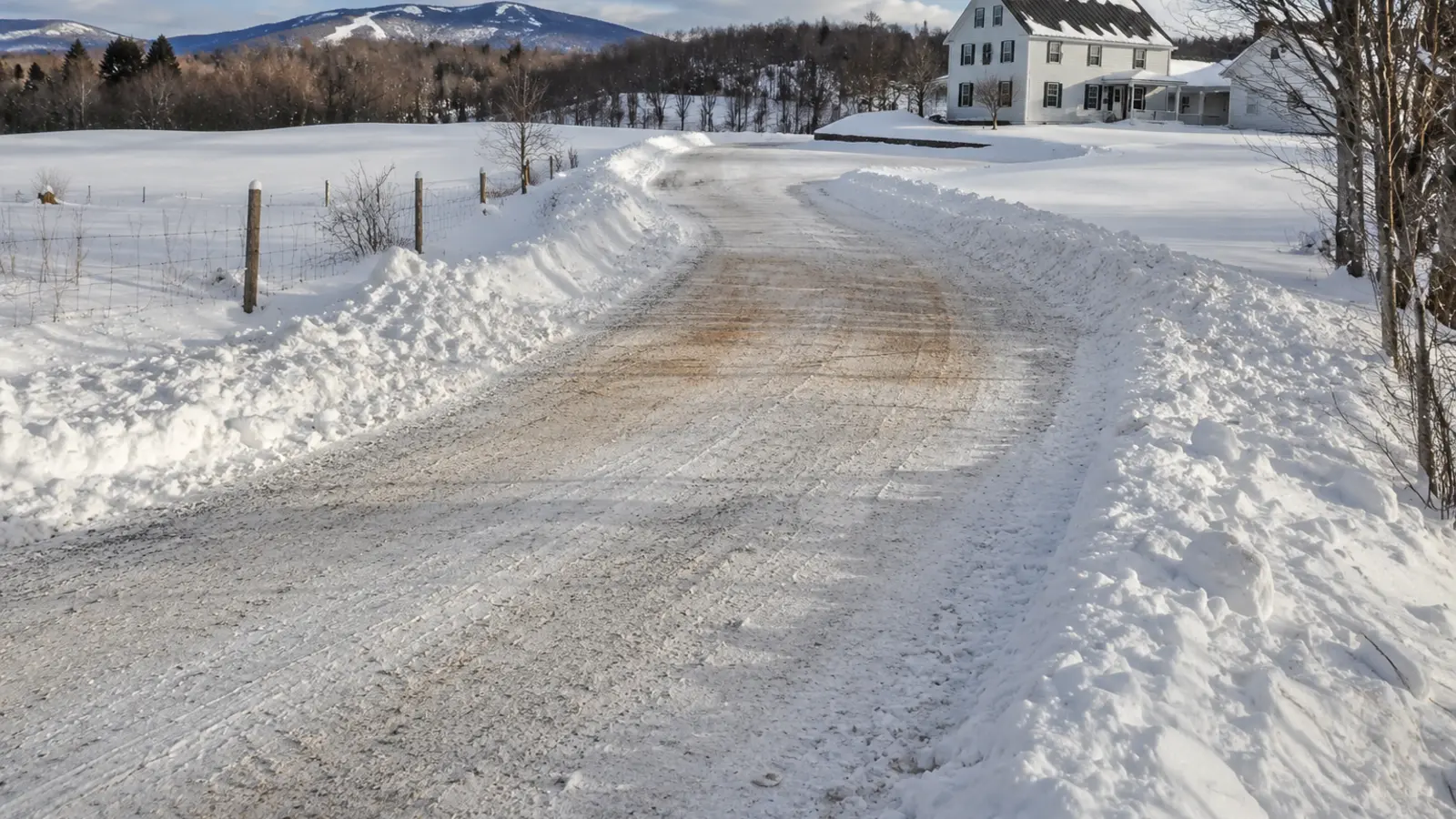
Scope reference
What is included and what is quoted separately
| Typically included | Quote separately |
|---|---|
| Single- and multi-car driveways | Walkway or sidewalk treatment |
| Long rural and gravel drives | Snow widening or hauling |
| Turnarounds, garage aprons, and mail areas | Moved-vehicle cleanup |
| Per-visit or seasonal planning | Hidden-object repair |
Related winter work
Related winter services
Scope decisions rarely stand alone. See every option on the snow and ice services page.
Straight answers
Questions to settle before the snow flies
How much does residential snow plowing cost in the Champlain Valley?
A short paved driveway with room to turn commonly runs $40–$100 a visit. A long approach, a gravel surface, a hill, or a drive with no turnaround pushes it toward $50–$200. Seasonal residential agreements usually land between $300–$700. Checked September 2026. What actually sets your number is the time on site, not the frontage: a drive that needs six reversing manoeuvres costs more than a straight run twice as long.
How many inches of snow before a residential plow arrives?
Most residential agreements in this region trigger at 2–3 inches. Below that, the accumulation is generally driveable and the visit is not billed. The number itself matters less than three things around it: where the depth is measured (your property or a regional station), whether a long storm gets an opening pass partway through, and what happens to an event that stops at 1.8 inches and then glazes overnight.
Will a plow damage my lawn, driveway or landscaping?
Edge damage is the most common complaint and almost always traces to one of three causes: an unmarked boundary, a blade that is not set for the surface, or snow stacked where spring melt drags gravel and sand into turf. Markers set in autumn along the driveway edges, at culverts, at surface changes and beside anything that disappears under snow prevent most of it. Anything hidden and unmarked that gets struck is generally the owner's exposure, not the operator's: which is why the autumn walk-through matters more than any clause.
Do I need to move my car for the plow?
Yes, or agree in advance what happens if you have not. A vehicle in the drive turns a four-minute visit into a partial clear and a return trip, and the agreement should say which of those you are buying. Practical arrangement for a household: one designated space that stays clear during an event, cleared first. So the drive can be finished in a single pass.
Does residential plowing include shovelling the steps and front walk?
Not unless it is written in. Truck plowing and pedestrian clearing are separate services with different equipment, a plow cannot clear a step, and walkway work commonly runs $25–$75 an hour. There is also a sequencing problem: a plow pass throws a bank across the bottom of a walk. So a walkway cleared first gets buried. If you want both, the agreement needs to say the order.
What happens if I am away for the winter?
Tell the contractor, in writing, before the season. An unoccupied property changes the calculus: nobody is moving vehicles, nobody reports a missed visit, and accumulated ice at an entry can become a real hazard for a delivery driver or a check-in visitor. Some owners drop to a reduced scope that keeps the drive passable for emergency access, not fully cleared, which is cheaper and safer than an unmonitored full scope.
Can two neighbours share one residential plowing agreement?
Often yes, and it usually reduces both prices because the operator makes one trip. What it needs is a single named person who authorises work and receives the invoice, and a clear statement of where one property's service ends. Shared arrangements fall apart over the middle twenty feet and over who pays when one household wants an extra pass.
Is a snowblower cheaper than hiring a plow?
For a short paved drive with somewhere to throw the snow, frequently yes, and it is the right answer for a lot of households. It stops being the right answer where the drive is long enough that clearing takes over an hour, where the snow has nowhere to go after a few storms, where there is a grade, or where the person operating it should not be doing that work in February. Those are the honest thresholds, not driveway length alone.
What does "one visit" actually include on a residential property?
Whatever the agreement defines, which is why an undefined scope produces January arguments. A complete definition names the surfaces cleared, the width, whether the garage apron and turnaround are included, whether the mailbox approach is included, whether a return after vehicles move is included, and what is left when something blocks access. "The driveway" is not a definition.
Why is my neighbour paying less for the same driveway?
Usually because it is not the same driveway, or not the same scope. Route position, surface, backing distance, where the snow can be stacked, the trigger depth, whether treatment is included, and whether they signed in September while you asked in December all move the number independently. Compare the written scopes before concluding anyone is being overcharged.
Does residential plowing handle the ridge the town plow leaves at the end of my drive?
Only if the agreement says so, and this is the single most predictable dispute in the region. The municipal wing throws a dense, compacted ridge across every private apron, frequently after a private contractor has already finished. Decide before the season whether the return for that ridge is included, billable, or excluded.
How early should I arrange residential plowing?
Late summer to early autumn. Routes fill in the order requests arrive, and the pre-season walk-through that makes a scope honest is only possible while edges, drains and hazards are visible. A December request is quoted from a photograph and placed on whatever route still has a gap.
Can residential plowing keep my driveway completely clear all winter?
No, and an agreement promising it should be read carefully. Plowing removes accumulation down to a working surface; it does not produce bare pavement, prevent a refreeze after a thaw, stop freezing rain glazing what was just cleared, or keep drifting from refilling an exposed drive an hour later. Responsibility for the property's condition stays with the household that lives there.
Where the price figures come from
Every dollar range on this page is taken from these published cost guides, read September 2026. They are planning ranges, not quotes.
- HomeBlue, Snow Removal Cost in Burlington, Vermont (published October 12, 2022): Burlington plowing runs $40 to $100 a visit by driveway size; snow blowing $51 to $77 an hour.
- HomeAdvisor, What Is the Cost of Snow Removal? (updated June 19, 2026): Seasonal contracts $200 to $700; sand and salt $20 to $40 a visit; commercial plowing $50 to $200 an hour; $51 to $203 a visit overall.
- Angi, How Much Does Snow Removal Cost? (updated April 6, 2026): Seasonal contracts $300 to $700; $51 to $203 a visit, averaging $126.
- HomeGuide, Snow Removal Cost (2026): Driveway up to 90 feet $30 to $70; steep or gravel $50 to $100 and up; salt $20 to $65 an application; sidewalk clearing $25 to $75 an hour.
- Housecall Pro, Snow Removal Price Guide 2026 (updated March 12, 2026): Seasonal contracts $350 to $600; on-site hauling $100 to $600 a visit; loader or skid-steer stacking $100 to $200 an hour.