Greater Burlington winter service
Parking Lot Plowing
Plowing patterns designed around cars, islands, loading, drainage, and limited snow storage.
Build a snow planning range✓ Retail, office, industrial, and multifamily lots
✓ Opening and cleanup passes
✓ Parking-space reclamation
✓ Loader stacking and off-site hauling
Service in plain language
Preserve parking capacity, traffic flow, and safe access through the full season.
The cleanest commercial result comes from planning traffic flow and snow storage together. Piles should not block signs, sightlines, drains, accessible routes, or delivery movements. When lots stay occupied, service may be phased: open the main circulation lane, clear priority entrances, return after vehicles move, and document exceptions that could not be serviced. A lot that fills early needs a different visit order than one that empties out overnight. So the schedule should follow how the property is actually used, not only its layout on a site plan. Confirm where displaced snow may legally sit through a multi-day cold stretch. A pile that looked fine after the first storm can block a drain, a sightline, or a fire lane by the third one, and that is a property-manager decision, not a judgment call made by the plow operator at 3am.
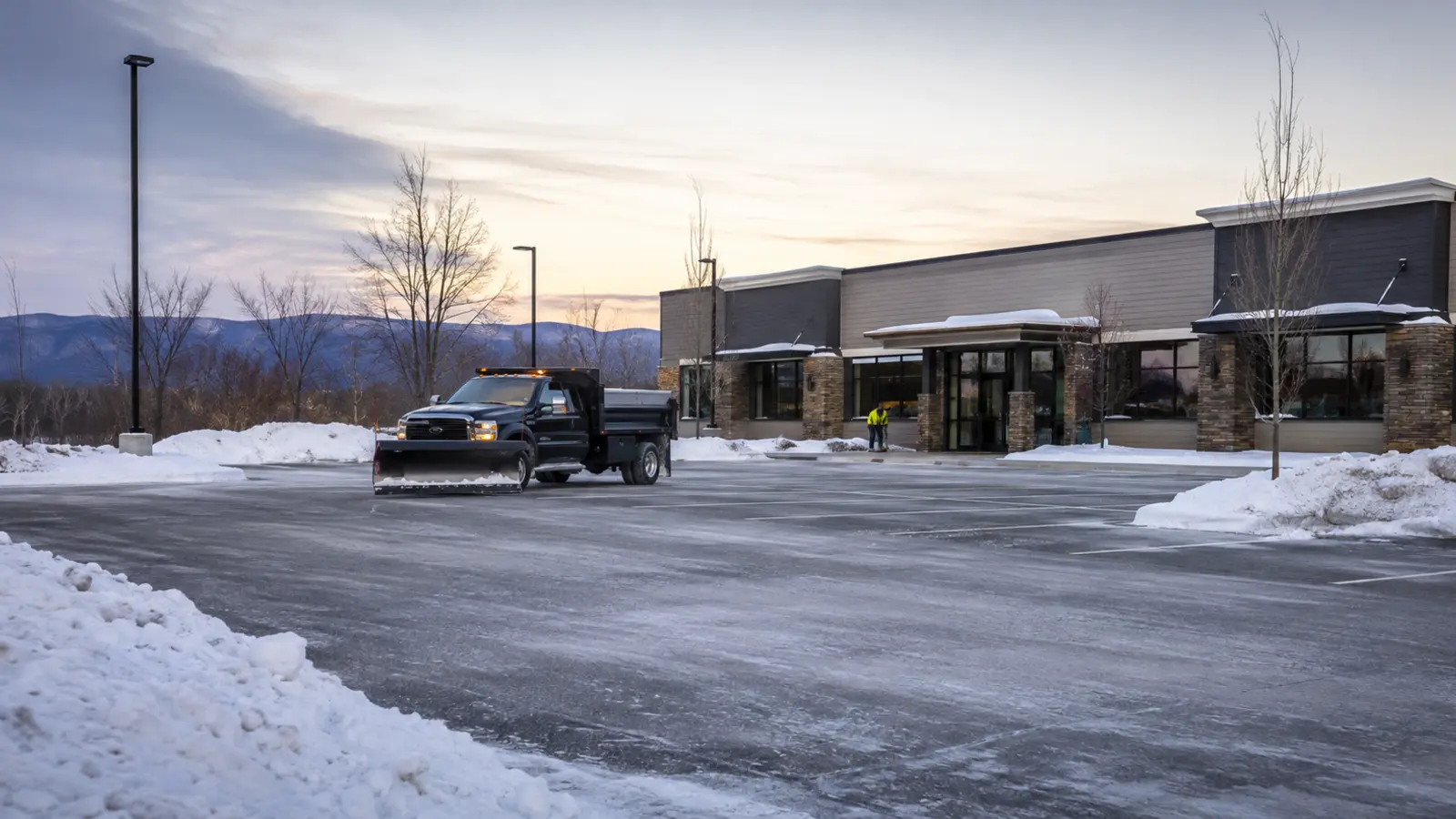
Parking lot plowing around parked cars and deliveries
Lot plowing by the hour runs $50–$200. Lot triggers usually sit at 1–2 inches.
Price bands checked September 2026: HomeBlue, HomeAdvisor, Angi, HomeGuide, Housecall Pro.
Scope reference
What is included and what is quoted separately
| Typically included | Quote separately |
|---|---|
| Retail, office, industrial, and multifamily lots | Walkway or sidewalk treatment |
| Opening and cleanup passes | Snow widening or hauling |
| Parking-space reclamation | Moved-vehicle cleanup |
| Loader stacking and off-site hauling | Hidden-object repair |
Related winter work
Related winter services
Scope decisions rarely stand alone. See every option on the snow and ice services page.
Straight answers
Questions to settle before the snow flies
How is parking lot plowing priced?
By serviced area, the number of separate zones, the obstacles that dictate the pattern (islands, light poles, curbing, bollards), the trigger depth, and how far snow has to be pushed to reach approved storage. Commercial plowing billed by time commonly runs $50–$200 an hour. The variable people underestimate is push distance: a lot whose only storage is at the far corner costs meaningfully more per event than an identical lot with a near-side bank.
How much parking do we lose to snow storage over a winter?
More than most operators plan for, and it compounds. Each event adds to the same piles, and piles occupy stalls plus the aisle space needed to build them. A lot that has not identified storage in advance typically starts losing prime stalls near the entrance, which is the capacity the business most needs. Decide in autumn which stalls are sacrificed, in what order. It is a business decision, not an operational one.
Where can snow legally be piled in a parking lot?
Not on accessible parking spaces or their access aisles, not blocking a fire lane, a hydrant or a sightline at an exit, not over a catch basin or drainage swale, not against a building where meltwater runs back to an entrance, and not into the public right of way or onto an adjoining property. In many lots those exclusions leave one or two viable areas, which is precisely why they should be identified and ranked before the first storm.
What is the right plowing pattern for a lot?
The one that moves snow toward storage in the fewest passes without crossing pedestrian routes or blocking circulation, and it gets worked out on a map. Improvising it on the fly is how corners get missed. Generally the pattern opens the main circulation spine first so vehicles can move, works the aisles toward the designated storage, and finishes at the perimeter, but islands, one-way flow, loading movements and where the accessible routes run all reshape it per site.
How are accessible parking spaces handled?
As a priority, and explicitly named on the map. Accessible spaces and the striped access aisles beside them have to be cleared to the surface and kept clear. An access aisle used as a snow bank makes the space unusable, and it is the failure most likely to be noticed and complained about. They also need clearing to the connecting route, not just the stall.
What happens to stalls with cars parked in them?
They stay unserviced and ice up under the vehicle unless a return pass is arranged. Occupied lots need either a phased plan with a documented return after vehicles move, or a tenant-communicated relocation instruction during events. Whichever it is has to reach the people who actually park there, which is the property manager's job, not the contractor's.
Do parking lots need salt after every plow?
No, and applying it by habit is expensive and environmentally poor practice. Treatment is a decision about pavement temperature, precipitation type, the forecast, expected traffic and refreeze risk. A scope should name the treatment zones, entrances, the main circulation lane, the accessible routes, the pedestrian crossings, and the conditions authorising application, at around $20–$60 a visit at residential scale and proportionally more across a full lot.
How do drainage structures affect lot plowing?
They dictate where snow cannot go. Burying a catch basin means the meltwater from every pile finds another route, usually across the lot surface, where it refreezes and produces a hazard nightly through a thaw. Mark drainage on the map, keep piles off it and downgradient of the traffic areas, and the lot largely manages its own melt.
When does a lot need a loader instead of a truck?
When the piles are taller than a truck plow can add to, when reclaiming stalls requires relocating an existing bank instead of pushing new snow, or when the storage areas need compacting to buy more capacity. Loader time commonly runs $100–$200 an hour, and it is usually cheaper than hauling as long as the site still has somewhere to put the snow.
When should we haul snow off site instead?
When the site is genuinely out of storage, when stall loss is costing the business more than the haul, when piles block sightlines or accessible routes that cannot be relocated, or when another storm is forecast onto a full lot. Hauling commonly runs $100–$600 a visit depending on volume and distance, and the trigger should be agreed in advance so it is a planned expense, not an emergency one.
How long after a storm should a lot be fully clear?
That is a scope decision, and it should be stated as a target, not a promise. Realistically it depends on where the lot sits in the route, how long the event ran, whether vehicles cleared, and whether the storm ended at 4am or 4pm. A commercial scope that promises a fixed completion time regardless of conditions is promising something no operator controls.
Does the lot scope include the entrance from the public road?
It should say so explicitly. The apron where a lot meets the public road gets a municipal berm across it, is the highest-traffic point on the property, and is frequently the spot with the least room for storage. Leaving it unassigned means it is cleared by whoever gets to it, or by nobody.
Can a parking lot be kept free of ice all winter?
No. A managed lot is one where accumulation is removed promptly, treatment is applied where and when it does useful work, and the conditions are documented. It is not a lot that is free of ice: refreeze after a thaw, freezing rain, meltwater tracking from piles and traffic compaction all produce ice on well-managed lots, and any contractor promising otherwise is selling something they cannot deliver.
Where the price figures come from
Every dollar range on this page is taken from these published cost guides, read September 2026. They are planning ranges, not quotes.
- HomeBlue, Snow Removal Cost in Burlington, Vermont (published October 12, 2022): Burlington plowing runs $40 to $100 a visit by driveway size; snow blowing $51 to $77 an hour.
- HomeAdvisor, What Is the Cost of Snow Removal? (updated June 19, 2026): Seasonal contracts $200 to $700; sand and salt $20 to $40 a visit; commercial plowing $50 to $200 an hour; $51 to $203 a visit overall.
- Angi, How Much Does Snow Removal Cost? (updated April 6, 2026): Seasonal contracts $300 to $700; $51 to $203 a visit, averaging $126.
- HomeGuide, Snow Removal Cost (2026): Driveway up to 90 feet $30 to $70; steep or gravel $50 to $100 and up; salt $20 to $65 an application; sidewalk clearing $25 to $75 an hour.
- Housecall Pro, Snow Removal Price Guide 2026 (updated March 12, 2026): Seasonal contracts $350 to $600; on-site hauling $100 to $600 a visit; loader or skid-steer stacking $100 to $200 an hour.