Greater Burlington winter service
Salting & Deicing
Salting & Deicing: anti-icing and post-storm treatment options for paved driveways, lots, entrances, and walkways.
Build a snow planning range✓ Rock salt and calibrated application
✓ Pre-treatment when conditions support it
✓ Post-plow bonding reduction
✓ Spot treatment for recurring ice
Service in plain language
Targeted pavement treatment based on temperature, surface, and expected traffic.
Deicing is not one-size-fits-all. Pavement temperature, precipitation type, timing, dilution, traffic, refreeze risk, and nearby landscaping all matter. More material is not automatically better. A responsible plan defines the areas to treat, the trigger for application, and conditions where sand or a different approach is more appropriate. Confirm in writing which surfaces are excluded from a treatment visit. A shaded loading dock or a north-facing walkway often needs a different trigger than the rest of the property, and one blanket schedule can leave exactly those spots undertreated. Pavement age and sealant condition matter too: a newly sealed surface can be more sensitive to certain deicing materials in its first season. So ask what material is planned and whether it suits the specific pavement before agreeing to a standing treatment plan. Waiting until ice has already formed is too late to ask.
Where salting and deicing work, and where they fail
Salt applications run about $20–$60 each. Salt slows sharply in deep cold.
Price bands checked September 2026: HomeBlue, HomeAdvisor, Angi, HomeGuide, Housecall Pro.
Scope reference
What is included and what is quoted separately
| Typically included | Quote separately |
|---|---|
| Rock salt and calibrated application | Bare pavement guarantee |
| Pre-treatment when conditions support it | Unlimited re-applications |
| Post-plow bonding reduction | Drainage correction |
| Spot treatment for recurring ice | Spring surface sweeping |
Related winter work
Related winter services
Scope decisions rarely stand alone. See every option on the snow and ice services page.
Straight answers
Questions to settle before the snow flies
What does salting cost per application?
A residential-scale application commonly runs $20–$60; commercial lots price by treated area and by the material, and a site treating a full lot plus entrances several times in one freeze-thaw week can spend more on material than on plowing that week. Checked September 2026. The number to watch on a commercial scope is not the unit price but how many applications a winter's conditions will authorise.
At what temperature does road salt stop working?
Rock salt works by forming brine, and its practical range narrows sharply as pavement temperature falls: well before the theoretical limit. The reaction slows and traffic is needed to work it in. Below the working range it sits on the surface as loose granules doing very little except costing money and ending up in the soil. Deep-cold events in this region are usually a traction problem for that reason, not a melting one.
Is pavement temperature the same as air temperature?
No, and confusing the two produces most bad treatment decisions. Pavement holds and loses heat on its own schedule: it can be well below freezing under above-freezing air on a clear night, and above freezing under cold air in direct afternoon sun. Treatment decisions on a managed site should be made on pavement temperature, which is why professional operators carry an infrared thermometer.
Does more salt work better?
No. Beyond the amount needed for the conditions, additional material does not melt more; it runs off, ends up in soil, groundwater and nearby surface water, damages concrete and vegetation, and tracks indoors. Over-application is the most common failure in this service, and it is usually a symptom of applying by habit instead of to a stated trigger.
Will salt damage my concrete, my lawn or my dog?
It can do all three. Chloride is aggressive toward concrete, particularly newer, spalled or poorly-cured surfaces, accumulates in adjacent soil to the detriment of planting, and irritates paws. Where those matter, the answer is usually to restrict salt to the surfaces that need it, use sand elsewhere, and keep application off planting beds and away from a lawn edge. Eliminating treatment entirely is rarely the answer.
Does salting work on a gravel driveway?
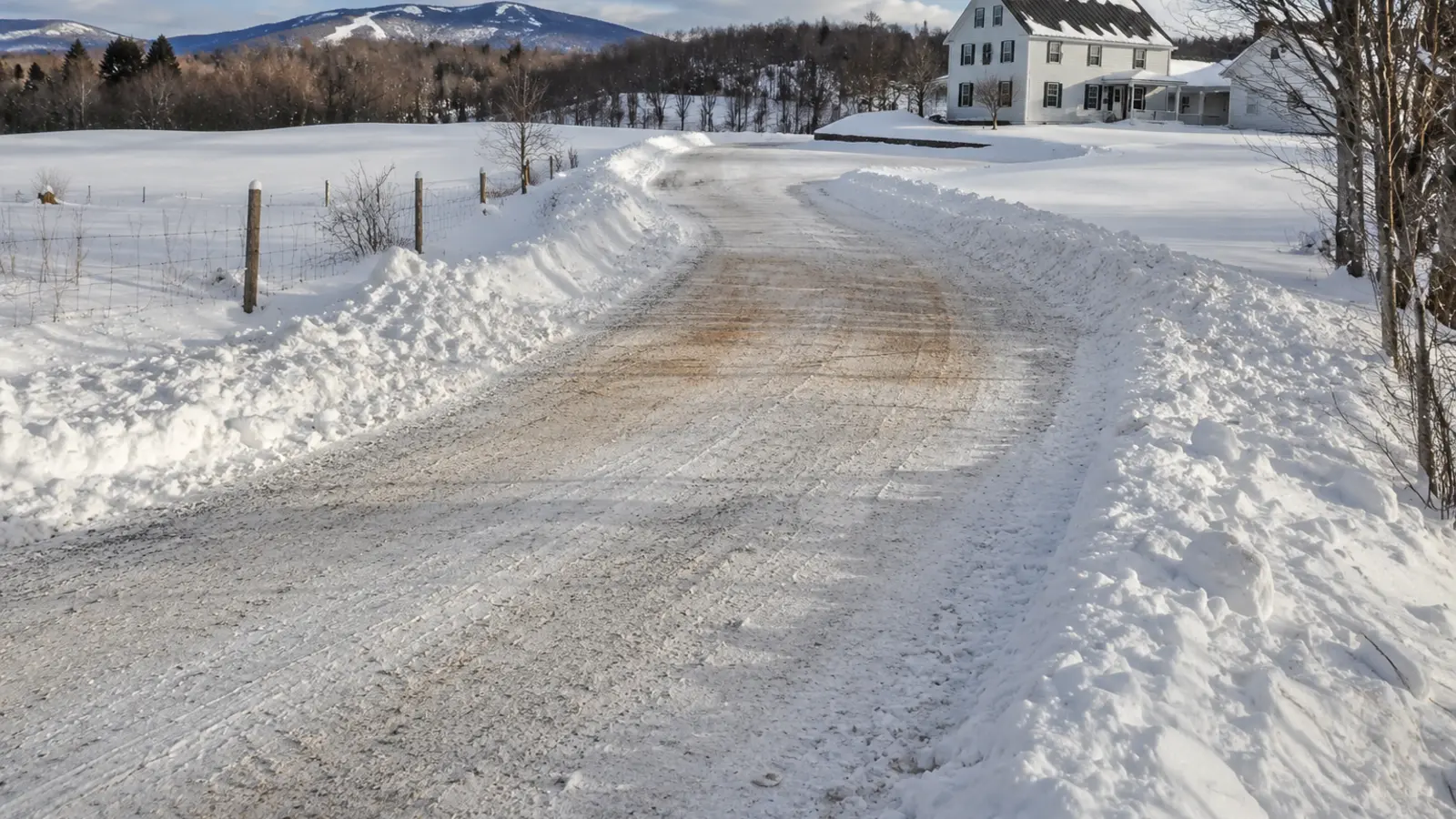
Essentially no, and it is worth understanding why. Deicing chemistry acts on a bond between ice and a hard surface; a gravel surface has no such bond in the same sense, and the material mostly loosens the top layer and washes into the shoulder. Gravel surfaces need sand for mechanical traction, at around $20–$60 an application.
When should salt be applied: before, during, or after a storm?
Applied after the plowing pass in most cases, because a pass over a treated surface scrapes off the material. Applied before an event, it is a different service, anti-icing, with a different purpose and different conditions. Applied during an event on an actively accumulating surface it is generally wasted. The scope should say which of the three is being bought.
Does salting mean the surface will be bare pavement?
No, and a scope promising bare pavement should be read closely. Treatment reduces the bond and, with traffic and suitable temperatures, can produce a largely clear surface. In a Vermont freeze-thaw week, on a shaded section, or during freezing rain, it will not, and no quantity of material changes that.
What surfaces should never be salted?
Newer or already-spalling concrete, most decorative and stamped surfaces, surfaces draining directly to a stream or pond without any buffer, and areas immediately adjacent to planting that matters to you. Those are the zones where a scope should name sand or a different product, and marking them on the site map in autumn is what makes that instruction survive a 3am application.
Are there alternatives to rock salt?
Several, with real trade-offs: treated salts and liquid brines that extend the working range or reduce total material, magnesium and calcium products that work colder but cost more and behave differently on concrete, and blends with sand for traction. Which is appropriate depends on the surface, the temperatures the site actually sees, and the environmental context. The choice belongs to the contractor and the product label, not to a website.
How is deicing different from anti-icing?
Deicing breaks a bond that has already formed after an event. Anti-icing is applied to a clean, dry, suitable surface before an event to make that bond weaker and easier to remove later. They use different timing, different conditions, and sometimes different materials, and buying one while expecting the other is a common and expensive mismatch.
Who decides when a deicing application happens?
The scope should, in advance: by naming the conditions that authorise it and whether repeat applications within an event are pre-approved. Otherwise every application is a phone call, and the calls happen at the least convenient hours. A stated threshold plus a spending cap covers almost every real situation.
Does a treated surface stop being slippery?
It becomes less slippery under the conditions the treatment suits. It does not become safe, and it does not stay treated: meltwater dilutes the brine, traffic carries it away, a temperature drop refreezes what melted, and freezing rain lays new ice over the top. Treatment is a risk-reduction measure, and the property's own duty of care does not transfer to whoever applied it.
Where the price figures come from
Every dollar range on this page is taken from these published cost guides, read September 2026. They are planning ranges, not quotes.
- HomeBlue, Snow Removal Cost in Burlington, Vermont (published October 12, 2022): Burlington plowing runs $40 to $100 a visit by driveway size; snow blowing $51 to $77 an hour.
- HomeAdvisor, What Is the Cost of Snow Removal? (updated June 19, 2026): Seasonal contracts $200 to $700; sand and salt $20 to $40 a visit; commercial plowing $50 to $200 an hour; $51 to $203 a visit overall.
- Angi, How Much Does Snow Removal Cost? (updated April 6, 2026): Seasonal contracts $300 to $700; $51 to $203 a visit, averaging $126.
- HomeGuide, Snow Removal Cost (2026): Driveway up to 90 feet $30 to $70; steep or gravel $50 to $100 and up; salt $20 to $65 an application; sidewalk clearing $25 to $75 an hour.
- Housecall Pro, Snow Removal Price Guide 2026 (updated March 12, 2026): Seasonal contracts $350 to $600; on-site hauling $100 to $600 a visit; loader or skid-steer stacking $100 to $200 an hour.