Price drivers
Pile density, loader access, truck cycles, disposal, traffic, and work-hour limits drive the cost of loader snow stacking.
Greater Burlington winter service
Loader support for stacking, consolidation, pile relocation, and parking-capacity recovery on larger properties.
Model the property✓ Commercial and multifamily properties
✓ Pile consolidation and relocation
✓ Loading-zone and sightline recovery
✓ Planned support before major storms
Service in plain language
Loader support for stacking, consolidation, pile relocation, and parking-capacity recovery on larger properties.
Loader work is useful when ordinary plows cannot push farther, snow must be stacked vertically, or frozen banks need to be broken down and relocated. The site plan should identify pavement edges, curbs, islands, utilities, drains, and legal stacking zones.
The scope should distinguish on-site relocation from off-site hauling. Mobilization, machine size, operating room, pile condition, traffic, and working-hour restrictions all affect the service.
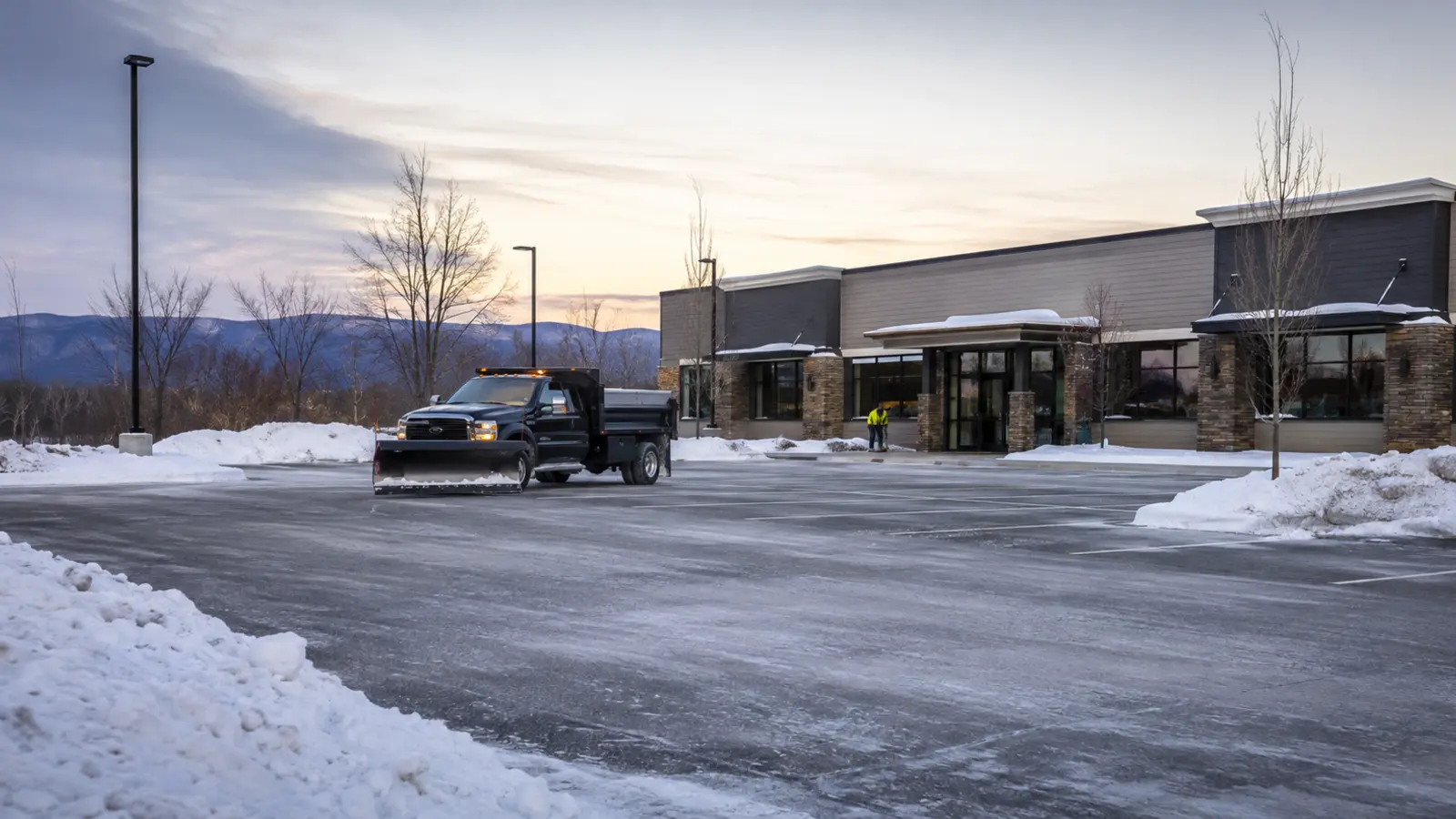
Operating decision
On a loader snow stacking property, bank work starts when the site loses usable width, parking, drainage, visibility, or storage for the next storm—not only when equipment can no longer push.
On a loader snow stacking property, state whether snow stays on site, moves to another approved location, or leaves by truck. For loader snow stacking, loader access, truck cycles, disposal, and work hours change the price.
For loader snow stacking, the proposal should name the activation point, mapped work area, visit standard, exceptions, and separately authorized work.
Pile density, loader access, truck cycles, disposal, traffic, and work-hour limits drive the cost of loader snow stacking.
For loader snow stacking, you set the priority access, the finish standard, the legal storage area, the treatment zones, and who may approve added work.
With loader snow stacking, walks, treatment, widening, hauling, moved vehicles, and hidden-object repair are not implied unless the scope names them.
Related winter work
See every option on the snow and ice services page.
Straight answers
Lift. A truck plow pushes at ground level and can only add to a pile up to the height its blade can climb; a loader picks material up and places it, so it can build a pile several times higher, compact it, and reclaim ground a truck has already given up. That vertical capacity is the whole reason loaders appear on commercial sites in February.
Commonly around $150–$275 an hour, billed for time on site including positioning. Checked September 2026. It is usually the cheapest way to recover capacity as long as the property still has somewhere to put the snow — hauling at around $200–$450 a load is the next step up, and it is several times the cost for the same volume.
When the constraint is height rather than reach: piles a truck can no longer add to, stalls that need an existing bank moved rather than new snow pushed, or an entrance where the bank has grown past what a blade can cut. A second truck on a site with no room simply moves the problem a few feet.
High enough to be stable and no higher, and stability depends on how it was built — compacted lifts hold far better than loosely tipped material. The practical limits are not just structural: a pile that blocks a sightline at an exit, shadows an accessible route, or overhangs a pedestrian area is a hazard regardless of whether it is stable.
Downgradient of the traffic surfaces so meltwater runs away rather than across them, clear of drainage structures, off accessible spaces and their access aisles, away from building entrances, and not where they shadow a route that then never thaws. Those constraints usually leave one or two viable areas on a given lot, which is why they are ranked on the site map in autumn.
It can, and a loader bucket on pavement is less forgiving than a plow blade. Operators generally work with the bucket slightly off the surface and rely on the compacted base, but curbing, islands, drainage grates and any raised element within the working area are all at risk and should be marked. The same applies to whatever is under the pile when spring reveals it.
By converting sprawling low piles into compact high ones, which frees the footprint the low piles occupied. A site that stacks properly in December can often get through a whole Vermont winter without hauling; a site that lets piles spread flat runs out of room by the same date and pays for trucks.
Between, in the gap after an event has been cleared. During an active storm the priority is maintaining usable surface, and a loader working the storage area occupies space the trucks need. Sites that schedule stacking as a post-event task rather than an emergency one spend considerably less on it.
Room to manoeuvre and turn, a route in that will bear the machine, and adequate overhead clearance — canopies, drive-throughs, low signage and overhead wiring all rule out otherwise obvious working areas. Sites with a single tight entrance may not be loader-serviceable at all, which is a fact worth establishing in autumn.
Yes, while it happens, which is why it is usually scheduled overnight or on a closed day. A loader working a storage area takes that section of the lot out of use and needs a clear working radius. Sites that need it regularly build the scheduling into the seasonal agreement instead of negotiating each time.
It melts long after the surrounding lot, leaves behind everything that was in it — sand, grit, litter, whatever was on the pavement — and produces meltwater for days from a single point. Planning where that water goes is part of choosing the location, and cleaning up what the pile leaves should be assigned in the agreement.
On many sites, yes, for most winters — which is the argument for doing it early and properly. It stops working when the property genuinely has no remaining footprint, when piles would block something that cannot be blocked, or when a stacked pile has grown past what the machine on site can safely build.
It restores capacity and removes obstructions; it does not address the surface conditions around the pile, and a freshly reclaimed area is usually compacted and icy until it is cleared and treated. Meltwater from a large pile is also one of the most reliable overnight ice sources on any commercial property.
Winter starts before the forecast
Map the property, choose the right service trigger, and decide where the snow should go before the first route rolls.